
Form Five Selection Criteria 2026 Explained: Who Qualifies and Why
Being selected to join government schools for Form Five and Form Six studies remains one of the most important academic milestones for secondary school graduates in Tanzania. Each year, thousands of students who complete their Certificate of Secondary Education Examination (CSEE) eagerly wait to find out whether they have met the official requirements to advance to advanced-level secondary education. Following the release of Form Four results by the National Examinations Council of Tanzania (NECTA), attention quickly shifts to one critical question: who qualifies for Form Five selection, and on what basis?
For the 2026 academic year, Form Five selection will continue to follow clearly defined criteria set by the Ministry of Education, Science and Technology. These criteria are designed to ensure fairness, academic merit, and effective allocation of the limited spaces available in government schools. This article provides a detailed and structured explanation of the Form Five Selection Criteria 2026, clarifying who qualifies and why certain students are prioritized.
Overview of Form Five Selection in Tanzania
Admission to government Form Five schools is highly competitive. The strong demand is largely driven by the quality of education offered and the relatively low school fees compared to private schools. As a result, meeting the minimum requirements does not automatically guarantee selection. Instead, students are assessed using a combination of academic performance, subject relevance, and available school capacity.
The Form Five selection process relies entirely on CSEE results and official guidelines issued by education authorities. Understanding these criteria is essential for students, parents, and guardians as they prepare for the next stage of secondary education.
Form Five Selection Criteria 2026 Explained
1. Academic Performance in CSEE Examinations
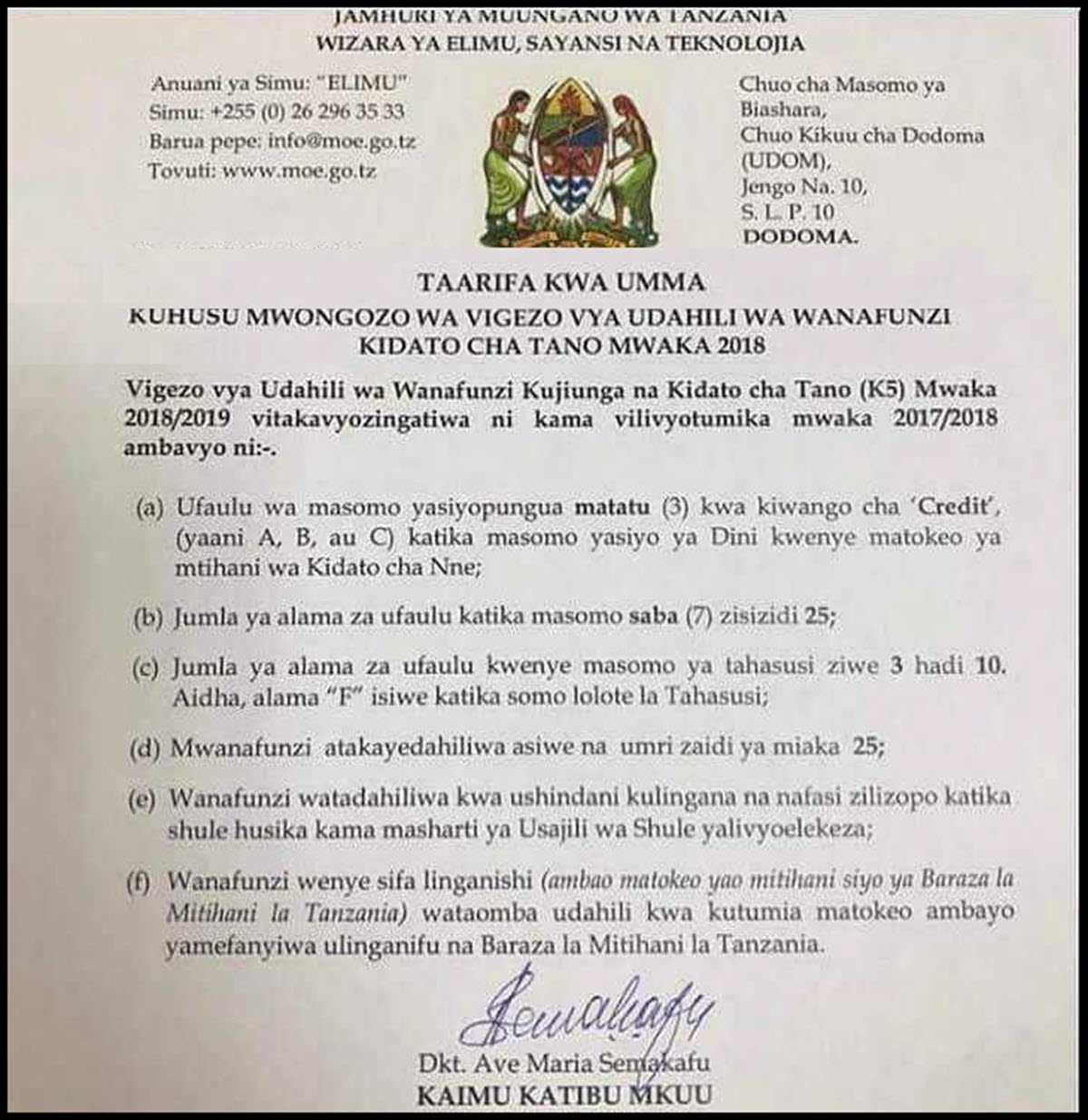
Academic achievement is the foundation of Form Five selection. To qualify, a student must have passed at least three (3) non-religious subjects at Credit level, meaning grades A, B, or C in the Form Four examinations.
It is important to note that:
- Only non-religious subjects are considered under this requirement.
- Passes in religious subjects do not count toward the minimum credit requirement.
This criterion ensures that students admitted to Form Five have demonstrated sufficient academic capability to cope with advanced-level studies.
2. Total Points in Seven Subjects
In addition to individual subject passes, overall performance is assessed using a points system. For Form Five selection in 2026, the total points from seven (7) subjects must not exceed 25.
This requirement emphasizes consistency in performance across multiple subjects rather than excellence in only one or two areas. Students with lower total points are generally ranked higher during the selection process, increasing their chances of securing a place in government schools.
3. Performance in Specialization Subjects (Combination Subjects)
Students are also evaluated based on their intended subject combinations for advanced-level studies. The total points in specialization subjects the subjects a student plans to pursue in Form Five must fall between 3 and 10.
Additionally:
- A student must not have a grade F (Fail) in any of the specialization subjects.
- Poor performance in a subject related to the intended combination can disqualify a student, even if other requirements are met.
This criterion ensures that students are academically prepared for the subject combinations they choose at the advanced level.
4. Age Requirement for Form Five Admission
Age is another factor considered during the selection process. For the 2026 intake, a student must not be older than 25 years at the time of admission. This guideline aims to maintain an appropriate age range within secondary schools and to prioritize students who progress through the education system without extended delays.
5. Competition and Availability of School Places
Form Five selection is conducted on a competitive basis, depending on the number of available spaces in each government school. Even students who meet all academic and age requirements may not be selected if:
- The school they applied for has limited capacity.
- Other applicants have stronger academic results.
As a result, selection outcomes are influenced not only by eligibility but also by overall performance relative to other candidates nationwide.
6. Consideration for Equivalent Qualifications
Students with equivalent qualifications, meaning results obtained outside the NECTA system, are also eligible for consideration. However, such candidates must:
- Apply using results that have been officially equated by NECTA.
This requirement ensures fairness and standardization when comparing results from different examination systems.
Why These Criteria Matter
The Form Five selection criteria are designed to balance merit, fairness, and resource limitations. By focusing on credit passes, total points, subject relevance, and age, education authorities aim to admit students who are best prepared for advanced secondary education while maintaining national academic standards.
For students, understanding these criteria helps set realistic expectations. For parents and guardians, it provides clarity on how selection decisions are made and why some qualified students may still miss out due to high competition.
Final Thoughts on Form Five Selection 2026
Qualifying for Form Five selection in 2026 requires more than just passing Form Four examinations. Students must demonstrate strong overall academic performance, meet subject-specific requirements, fall within the accepted age range, and compete successfully for limited school places.
Those who meet the criteria are encouraged to closely follow official announcements regarding selection results and registration procedures. For authoritative updates and detailed guidance, students and parents should refer to official communications from the Ministry of Education, Science and Technology and NECTA.
Understanding the Form Five Selection Criteria 2026 is a crucial step toward making informed academic decisions and preparing effectively for the next phase of secondary education in Tanzania.
Editor’s Picks:
- How To Check 2025 Namibia NSSCO and NSSCAS 2025 Exam Results
- NECTA Private Candidate Registration Requirements For Form Six Examination
- NECTA Announces Registration Dates and Fees for 2026 CSEE and FTNA Private
- NECTA A Level Grading System in Tanzania
- NECTA Releases 2026 Form Six Examination Timetable, Exams to Start in
- NECTA Releases 2026 Form Six Examination Timetable, Exams to Start in may