
Complete List of Form Five Subject Combinations (A-Level) in Tanzania
When a student completes Form Four and prepares to join A-Level education in Tanzania, selecting a Form Five subject combination becomes one of the most important academic decisions. This choice determines the area of specialization a student will follow for two years and strongly influences admission opportunities into higher learning institutions and future career paths. Choosing the right combination can therefore shape long-term academic success and professional direction.
This article provides a complete and well-organized list of Form Five subject combinations (A-Level) in Tanzania, grouped by specialization areas. The guide is designed to help students, parents, and educators clearly understand the available options and their academic relevance, especially at a time when higher learning institutions are directed to align curricula with job market demands.
Overview of Form Five Subject Combinations in Tanzania
Form Five subject combinations are structured into specific specialization categories.
Each category groups three subjects that are studied together throughout A-Level education. These combinations are designed to prepare students for specific academic disciplines, professional training, and skills development required by universities and colleges.
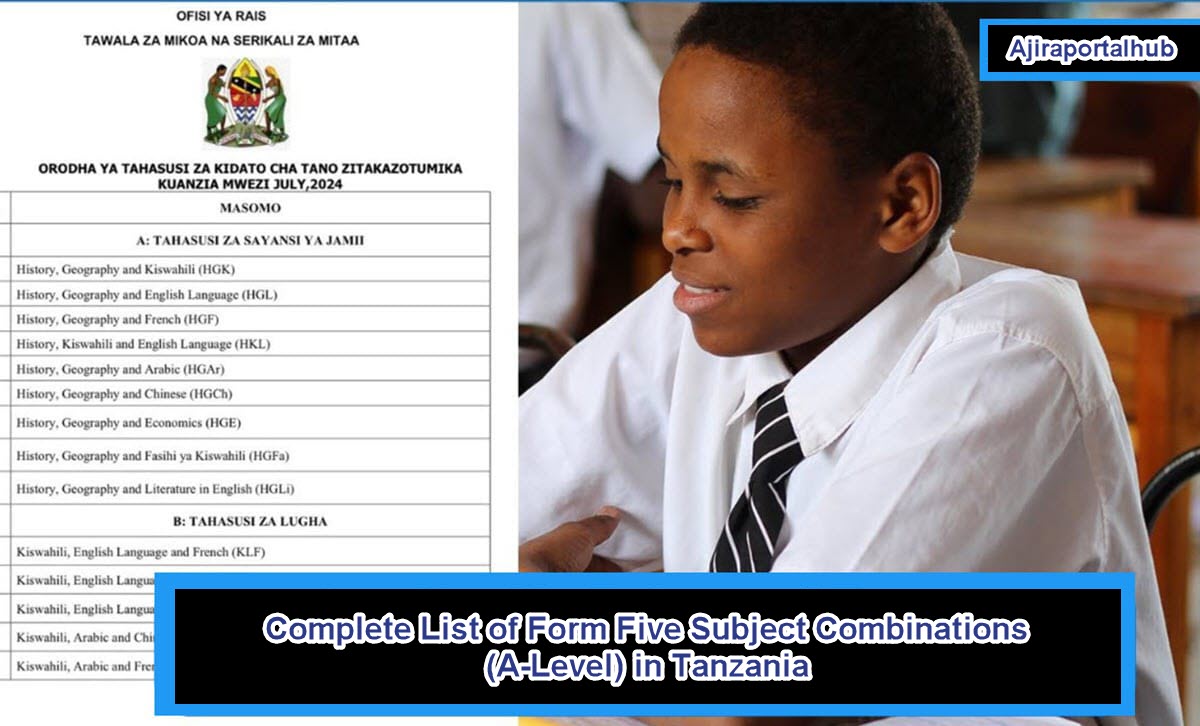
The main specialization areas include:
- Social Sciences
- Languages
- Business Studies
- Sciences
- Sports
- Arts
- Religious Education
Below is the full list of officially recognized combinations based on these categories.
Social Science Subject Combinations
Social science combinations focus on humanities, social analysis, and language-based studies. These combinations are commonly chosen by students interested in law, education, public administration, journalism, and social research.
- History, Geography and Kiswahili (HGK)
- History, Geography and English Language (HGL)
- History, Geography and French (HGF)
- History, Kiswahili and English Language (HKL)
- History, Geography and Arabic (HGAr)
- History, Geography and Chinese (HGCh)
- History, Geography and Economics (HGE)
- History, Geography and Fasihi ya Kiswahili (HGFa)
- History, Geography and Literature in English (HGLi)
These combinations emphasize analytical thinking, communication skills, and social awareness—competencies increasingly valued as higher learning institutions align curricula with job market demands.
Language Subject Combinations
Language combinations are designed for students with strong interest in communication, linguistics, translation, diplomacy, and education. They focus on language proficiency and cross-cultural understanding.
- Kiswahili, English Language and French (KLF)
- Kiswahili, English Language and Arabic (KLAr)
- Kiswahili, English Language and Chinese (KLCh)
- Kiswahili, Arabic and Chinese (KArCh)
- Kiswahili, Arabic and French (KArF)
- English Language, French and Arabic (LFAr)
- English Language, French and Chinese (LFCh)
- French, Arabic and Chinese (FArCh)
- History, English Language and French (HLF)
- History, English Language and Arabic (HLAr)
- History, English Language and Chinese (HLCh)
These combinations build strong language competence and critical communication skills, which remain relevant across multiple professional sectors.
Business Studies Subject Combinations
Business-related combinations prepare students for economics, commerce, accounting, and management-oriented programs. They support pathways into business administration, finance, entrepreneurship, and economic policy.
- Economics, Business Studies and Accountancy (EBuAc)
- Economics, Geography and Mathematics (EGM)
- Economics, Commerce and Accountancy (ECAc)
- Economics, Computer Science and Mathematics (ECsM)
- Business Studies, Accountancy and Computer Science (BuAcCs)
- Business Studies, Accountancy and Mathematics (BuAcM)
- Economics, Business Studies and Islamic Knowledge (EBuI)
These combinations reflect the growing need for analytical, financial, and digital skills as higher learning institutions are directed to align curricula with job market demands.
Science Subject Combinations
Science combinations are essential for students aiming to pursue professional and technical fields such as medicine, engineering, agriculture, and applied sciences.
- Physics, Chemistry and Mathematics (PCM)
- Physics, Chemistry and Biology (PCB)
- Physics, Geography and Mathematics (PGM)
- Chemistry, Biology and Geography (CBG)
- Physics, Mathematics and Computer Science (PMCs)
- Chemistry, Biology and Agriculture (CBA)
- Chemistry, Biology and Food and Human Nutrition (CBN)
These combinations emphasize quantitative reasoning, scientific analysis, and practical knowledge, making them highly competitive and market-oriented.
Sports Subject Combinations
Sports combinations integrate academics with physical education, nutrition, and performance studies. They are suitable for students interested in sports science, coaching, fitness, and health-related careers.
- Biology, Food and Human Nutrition and Sports (BNS)
- English Language, Music and Sports (LMS)
- Kiswahili, Music and Sports (KMS)
- Fasihi ya Kiswahili, Music and Sports (FaMS)
- Literature in English, Music and Sports (LiMS)
- French, Music and Sports (FMS)
- Arabic, Music and Sports (ArMS)
These combinations promote physical development alongside academic skills, supporting diverse career pathways.
Arts Subject Combinations
Arts combinations focus on creative expression, cultural studies, and practical artistic skills. They prepare students for careers in creative industries, education, and cultural institutions.
- Kiswahili, English Language and Theatre Arts (KLT)
- Kiswahili, French and Theatre Arts (KFT)
- Fasihi ya Kiswahili, English Language and Theatre Arts (FaLT)
- Kiswahili, Literature in English and Theatre Arts (KLiT)
- Kiswahili, English Language and Music (KLM)
- Kiswahili, French and Music (KFM)
- Fasihi ya Kiswahili, English Language and Music (FaLM)
- Kiswahili, Literature in English and Music (KLiM)
- Kiswahili, English Language and Fine Art (KLFi)
- Kiswahili, French and Fine Art (KFFi)
- Fasihi ya Kiswahili, English Language and Fine Art (FaLFi)
- Kiswahili, Literature in English and Fine Art (KLiFi)
- Kiswahili, Textile and Garment Construction and Fine Art (KTeFi)
- English Language, Textile and Garment Construction and Fine Art (LTeFi)
- Arabic, Textile and Garment Construction and Fine Art (ArTeFi)
- Chinese, Textile and Garment Construction and Fine Art (ChiTeFi)
These combinations develop creativity, design skills, and cultural literacy, aligning education with creative economy needs.
Religious Education Subject Combinations
Religious education combinations integrate theology with humanities and languages, preparing students for careers in education, religious leadership, and social services.
- Islamic Knowledge, History and Geography (IHG)
- Divinity, History and Geography (DHG)
- Islamic Knowledge, History and Arabic (IHAr)
- Divinity, History and English Language (DHL)
- Islamic Knowledge, History and English Language (IHL)
- Divinity, History and Kiswahili (DHK)
- Islamic Knowledge, History and Kiswahili (IHK)
- Divinity, Kiswahili and English Language (DKL)
These combinations emphasize moral studies, communication, and historical understanding.
Importance of Choosing the Right Subject Combination
- Form Five Subject combinations play a critical role in determining academic progression and career eligibility. Universities and colleges set specific entry requirements based on A-Level combinations, particularly for competitive programs such as medicine, engineering, economics, and education.
- Science combinations such as PCB and PCM are commonly required for medical and engineering fields, while social science and language combinations support pathways in law, education, and public service. Business-oriented combinations align with finance, commerce, and management careers.
- Beyond admissions, subject combinations shape transferable skills. Science combinations strengthen problem-solving and quantitative reasoning, while arts and language combinations enhance analytical writing and communication. This alignment supports national education goals, especially as higher learning institutions are directed to align curricula with job market demands.
Understanding the Complete List of Form Five Subject Combinations (A-Level) in Tanzania is very crucial for making informed academic decisions. Each combination offers unique opportunities and prepares students for specific academic and career pathways.
By carefully evaluating their interests, strengths, and future goals, students can select combinations that align with both higher education requirements and the evolving needs of the job market.
Editor’s Picks:
- Official NACTEVET Academic Calendar for 2025/2026 Pdf: Opening Dates, Exams, and Breaks
- VETA Joining Instruction Form 2026 PDF Download – Full Requirements & Fees
- Form Four (CSEE) Examination Registration Fees in Tanzania
- NECTA A Level Grading System in Tanzania
- Six Mandatory Subjects for FTNA 2026 Private Candidates Seeking CSEE Eligibility
- Government Jobs in Tanzania for Form Four Graduates